Beyond the War-Risk Headline: Underwriting Discipline and Structural Vulnerability in the Global Marine Insurance Market
Samuel Casey of Insurance Insider reported recently on two related trends in the marine insurance world. His first report reports that estimates by International Union of Marine Insurance (IUMI) put the marine war claims from the Middle East conflict at about $1.2-$2.0 billion. His subsequent analysis widens the discussion, suggesting that losses related to geopolitical and war may overshadow an underlying issue perhaps more likely to be a chronic factor in the general marine underwriting market conditions, deterioration. This paper builds on Casey's argument, and considers the relationship between the war-risk, excess insurance capacity, softening rates, attritional losses, cargo crime, and uncertainty around blocking and trapping exposures. It states that the biggest problem for marine insurers isn't just that one geopolitical loss event was so large, but that pricing discipline is becoming less while the environment for that risk is becoming more complex. It is important to note that headline premium growth need not be seen as an automatic sign of better market strength. Technical pricing, exposure transparency, accumulation management, contractual clarity and the future of emerging cargo and geopolitical risks will play a growing role in sustainable marine underwriting.
See IUMI 2026: War overshadows concerning trends in wider marine market and Marine war losses from Iran possibly approaching $2bn: IUMIʼs Denèfle
Introduction
One of the most apparent problems facing marine insurers has naturally been war risk. An incident involving physical damage or loss of a vessel, loss of hire, loss of cargo, rerouting of shipping, stranded property, and possible misunderstandings on policy wording are all examples of potential losses that can arise from conflict in important shipping lanes. It's a scene that can be seen clearly in a September 2026 report from Insurance Insider on the views of Samuel Casey.
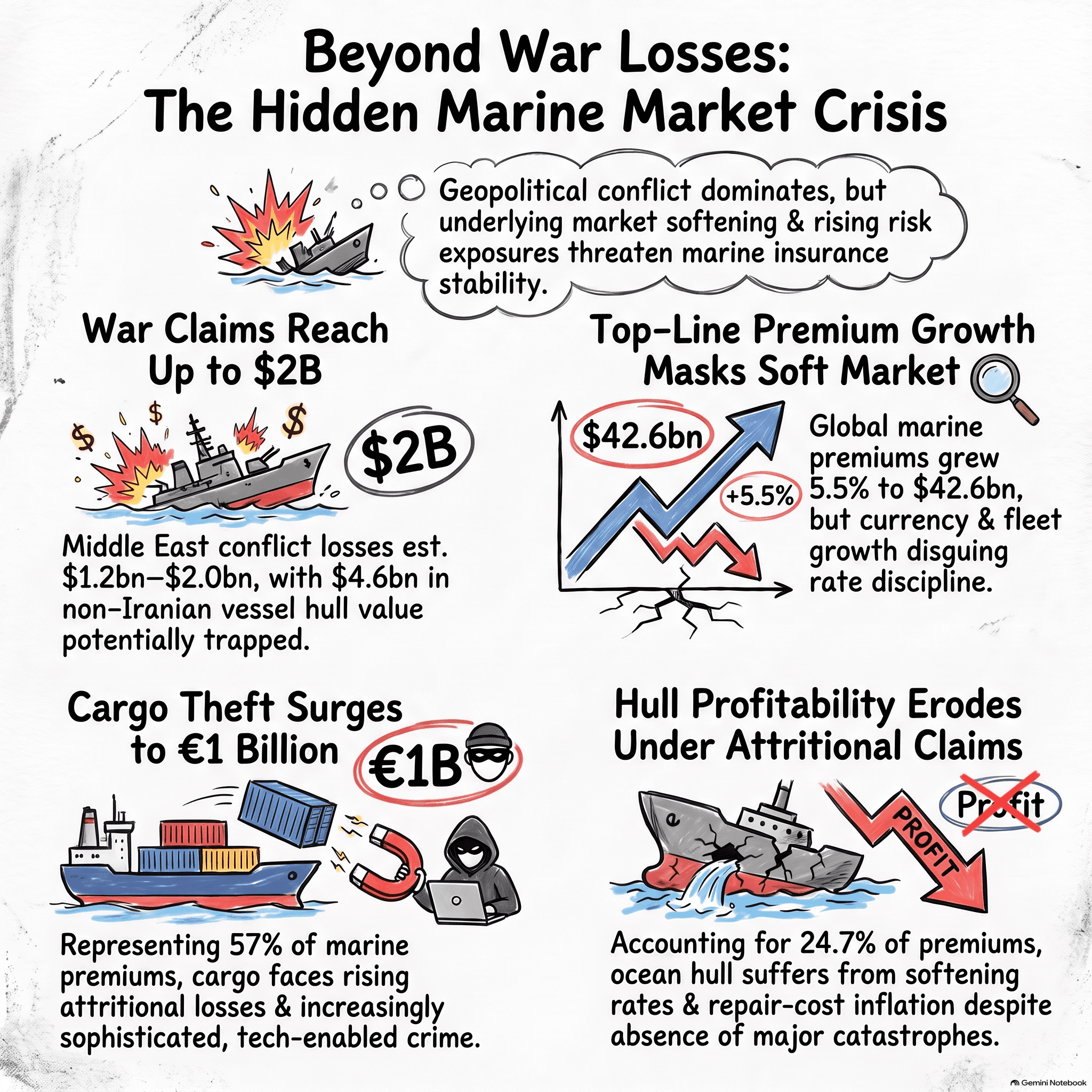
Casey shares IUMI's President Frédéric Denèfle's estimation that total marine war claims arising from the Middle East conflict could reach anywhere between some $1.2 billion and $2 billion, but he notes that the figure was far from certain, as it was estimated more by engaging in discussions with insurers and reinsurers than based on full claims statistics (Casey, 2026a). There were no "sure" figures to give, and the number was the result of a "very rough estimate," said Denèfle.
Three days later, Casey put those numbers into an even broader context of the market. He then goes on to say that overcapacity, rising competition, underwriting discipline and risk in hull and cargo insurance are other big issues that could be lost in the intense focus on geopolitical losses (Casey, 2026b).
This is a distinction that is relevant. A significant war loss is dramatic, quantifiable and will likely be a management priority. The deterioration of underwriting discipline is less visible and slower. But the latter may ultimately have greater impact as it impacts the profitability of a portfolio rather than any event or geographic area.
This paper thus builds upon Casey's analysis. It is the interplay between the growing complexity of risk and the erosion of price discipline that it says is the key problem for marine insurance. It's no longer just the question ‘How big will the war loss be??’ The real question is whether marine insurers are getting the proper compensation for the increasingly geopolitical, technologically complex, legally uncertain and interconnected operating environment.
The $2 Billion Estimate Should Be Viewed as a Signal, Not a Final Loss Number
While Casey's previous report is an important starting point, the range of $1.2-$2.0 billion is far from a precise assessment of the ultimate exposure of the industry. It clearly was an estimate, as Denèfle pointed out, based on market discussions, and there were still possibilities for further damage to vessels, cargo and equipment, he said (Casey, 2026a).
This separation has underwriting consequences. In an on-going battle, reported loss is but one part of total loss. Other losses may manifest themselves as business interruption, loss of hire, delayed cargo, constructive total loss claims, legal expenses and coverage disputes. The development patterns may thus turn out to be quite different from the relatively simple physical-damage patterns.
Later on, Caseys analysis is used to point to this example of blocking and trapping. He estimates that there are 226 ships stuck or materially held up in the Persian Gulf, worth an estimated $5.3 billion in total hull value. Importantly, this is estimated hull value and not insured value, and does not include cargo on board (Casey, 2026b). It is therefore an indicator of exposures, not losses covered.
That's a distinction that should be noted. While large exposure numbers are often mistakenly equated with potential future claims, the outcomes of insurance depend on the language of the policy, its terms of coverage, the extent of the deprivation, the cause of the deprivation, deductibles, limits and reinsurance provisions, as well as the situation of the particular vessel. Casey points out that there is legal uncertainty over whether the owners have been deprived continuously of the use of their vessels and on the facts of each claim.
The industry should therefore consider the present estimates of war loss as a distribution of possible loss scenarios, rather than the claim number. Scenario ranges will probably be more useful than a headline estimate for underwriting and capital.
The More Important Warning Is the Soft Market Beneath the Headline Growth
Perhaps most importantly, Casey broke apart premium growth and true market strength.
The value of global marine insurance premium rose by 5.5% in 2025 to about $42.6 billion. The cargo sector continued to be the biggest, accounting for about 57% of the total global marine premium, with ocean hull at 24.7%, offshore energy at 11.1%, and marine liability at approximately 7.3% (Casey, 2026a; IUMI, 2026a). In the short-term it could seem that premiums are improving due to their upward trajectory. This is a mistake for that interpretation.
The premium increase was mainly due to currency fluctuations, and the softness was largely due to increased capacity and competition, IUMI says. The case of a ship hull is particularly insightful. The value of the underlying hull market continued to soften but the growth of the fleet and exchange-rate movements, along with rising vessel values, played a major role in the increase of global hull premium, which reached $10.5 billion in 2025 (IUMI, 2026b).
The analytical difference is simple: premium growth does not equal rate adequacy. An insurer may be able to quote higher premiums due to two reasons: an increase in insured values, an increase in fleet sizes, and changing currencies or additional business. All of those conditions do not imply that the unit of risk price has gotten better.
So the problem that Casey is concerned with is not just that the rates are falling. It's declining or not increasing at all, and while the risk being insured grows more costly and unpredictable. It can be more lethal than an old fashioned soft market. Rate competition may just cause a reduction in margins if the severity of exposure and loss remain constant. As exposure complexity and loss severity rise, lack of adequate pricing can cause a delay between the apparent profitability and the appearance of adverse claims experience.
Attritional Losses Can Be More Informative than Catastrophic Events
Another important point noted by Casey in his earlier article for IUMI was that 2025 was not a big catastrophic loss in the marine sector to upset the balance of the market, but losses were continuing to accrue from attrition, especially in the ocean hull market (Casey, 2026a).
This can pose a behavioural challenge to the market. A few years of good underwriting can boost reportable underwriting results and enhance competition for premium. Recent profitability could be seen by capacity providers as an opportunity to take on more business. The underwriters can then feel compelled to slash premiums or offer more coverage to keep the accounts.
But what might be interpreted as a benign catastrophe experience doesn't necessarily mean that the risk environment is becoming better. The attritional loss deterioration can be especially significant as it implies the profitability is being undermined by lots of small claims as opposed to one big claim. These losses can be due to repair-cost inflation, increasing value of the vessels, operating complexity, disruption of the supply chain and other structural factors. These forces can last from one underwriting year to the next, unlike the one catastrophe.
Similarly, IUMI's latest hull analysis cautions that growth in the headline is not an indicator of higher rates or better profitability (IUMI, 2026b). And the risks are that if there are no big wins, this could mask poor foundation pricing. In the event of a significant geopolitical or natural event happening in addition to the growing attritional losses, insurers may find that they have already lowered the margin they planned for volatility.
Cargo Risk Is Becoming a Technology and Data Problem
Casey's follow-up article also needs to be expanded with a discussion about cargo theft. The premium of cargo accounts for the highest share, around 57%, of global marine premium. Casey says the premium for cargo rose to $24.2 billion in 2025, but that claims inflation was starting to be felt and attritional loss ratios were climbing. Simultaneously, supply chains were increasingly being the targets of organized criminals (Casey, 2026b).
Both IUMI and TAPA EMEA have independently raised alarms about cargo crime increasingly being made more digitally enabled, and theft and freight fraud being impacting supply chains in multiple regions (IUMI & TAPA EMEA, 2026). This alters the underwriting challenge.
The traditional cargo underwriting focuses mainly on commodity, value, route, packaging, mode of transportation, storage and physical security. Those variables still apply, but today, insurers need to be familiar with the information supply chain as well.
For instance, the underwriter might want to ask who's authorized to change the delivery instructions, who's authorized to authenticate carriers, whether digital identities are verified, how subcontractors are selected, whether shipment information is made public and what controls are in place for switching a route or consignee.
In that respect, cargo insurance is slowly becoming more cyber and more operational resilient. The asset itself could still be physical, but how criminals get their hands on it can be more and more "digital. There will therefore be no solution to the problem through pricing alone. Insurers could benefit from improved information sharing, tougher minimum-security standards and more distinction between sophisticated supply-chain controls and less.
War Books Cannot Reliably Compensate for Weak Core Underwriting
Another takeaway from Casey's analysis is in regard to portfolio cross-subsidization. There is clearly the potential for high premium in days of extreme geopolitical tension for war-risk business. This can make it seem as though high-yielding specialty books can offset a less than satisfactory performance in the traditional hull or cargo business.
This is a risky assumption. There is a lot of volatility, accumulation risk and event correlation in war insurance. Any escalation can impact multiple vessels, ports, cargo and business-interruption exposures at seemingly the same time. Questions and answers may also be open for a long time.
Casey directly mentions that profit making war books can't necessarily offset substandard hull results (Casey, 2026b). The general rule is that if one class of business is underwritten as a bad deal, then it should not be made a good deal because another class is underwritten as a good deal.
Although it is good to diversify, diversification and cross-subsidisation are not the same. Diversification relies on the assumption that risks are not the same and that volatility of the portfolio is lowered. In cross subsidization, it is assumed that there is a continuous balancing of the inadequate pricing at another place or inadequate prediction at another class. Those assumptions can come crashing down at just the wrong time in a systemic geopolitical event.
Implications for Marine Underwriters
Together, Casey's two articles imply that the underwriting philosophy should be less about forecasting the last number of war losses and more about enhancing portfolio resilience.
Firstly, insurers must separate out premium growth due to rate, exposure growth, insured value inflation and currency movements. If it didn't happen that way, top-line growth could give a false sense of improving market conditions.
Second, the management of the accumulated vessels should not be limited to physically damaged vessels. Stress scenarios should include blocking, trapping, loss of hire and cargo accumulation and concentration around strategic waterways. Even if a vessel has not suffered any physical damage, it can create an insurance problem if the vessel is not used for a period of time long enough to prevent its use for commercial purposes.
One of the three things that will become more important with wording is discipline. The conflicts that were foreseen over blocking and trapping are representative of the financial ramifications of ambiguity when old terms of a contract are used to new geopolitical situations.
Finally, digital supply-chain security should be more systematically integrated into cargo underwriting. As criminals are spreading their use of digital information and fake carrier identities, traditional physical security questionnaires will not fully address the risk.
That last is not the least, market discipline is still at the heart. Capacity is not a bad thing in and of itself. Competition can boost efficiency and increase insurance coverage. The issue comes when more capacity leads to the underwriters' discounting of new risk at a greater rate than the loss experience can accurately reflect.
Conclusion
In his article on 21 Sep, Samuel Casey posed an obvious question: would marine war claims, related to the Middle East conflict, hit $2 billion? The question he implicitly is raising in his Sept. 24 analysis is a more important one, and perhaps one that's broader, one that goes to the core of a market that already has soft rates, excess capacity and weak underwriting discipline: what do you do when a major geopolitical loss comes into the market?
The second question should be addressed more. There is no one single threat to the marine insurance market currently. Rather, they are facing double trouble: geopolitical war, stranded assets, coverage uncertainty, attritional hull losses, advanced cargo crime, increasing insured values, and technological evolution and competitive pricing.
In that case, it needs to be evaluated in terms of premium growth only. Nor should there be any overreliance on the profitability of recent years, or the fact that there have been no catastrophic losses to suggest that prices are adequate now.
What Casey has reported, then, is a lesson of discipline with risk taken. The estimated cost of the war of $1.2-$2.0 billion could be too low or too high. Where it's becoming more apparent, however, is the structural issue: marine insurance companies are being asked to underwrite a larger, more complex pool of risk, while the competitive pressures are also eroding their capacity to price it out.
That divergence, if it continues, may lead to a correction at the end of the day as a result of many minor corrective moments in pricing, attritional decline, accumulation events, and contractual uncertainty. The ability to maintain underwriting discipline in the face of an impending correction is likely to be a more significant issue for marine insurance companies at IUMI 2026.
References
International Union of Marine Insurance (IUMI). (2026a). Global marine insurance premiums rise but underlying market remains soft. 21 September 2026.
International Union of Marine Insurance (IUMI). (2026b). Ocean hull market faces growing risk pressures despite global premium growth. 23 September 2026.
International Union of Marine Insurance (IUMI) & Transported Asset Protection Association EMEA (TAPA EMEA). (2026). IUMI and TAPA EMEA warn of escalating cargo theft and freight fraud.
International Union of Marine Insurance (IUMI). (2026c). Global Marine Insurance Report 2026.