Academic Article: Functional Deception in Commercial Large Language Models: Cross-Model Evidence and Implications For AI-Assisted Decision-Making

Abstract
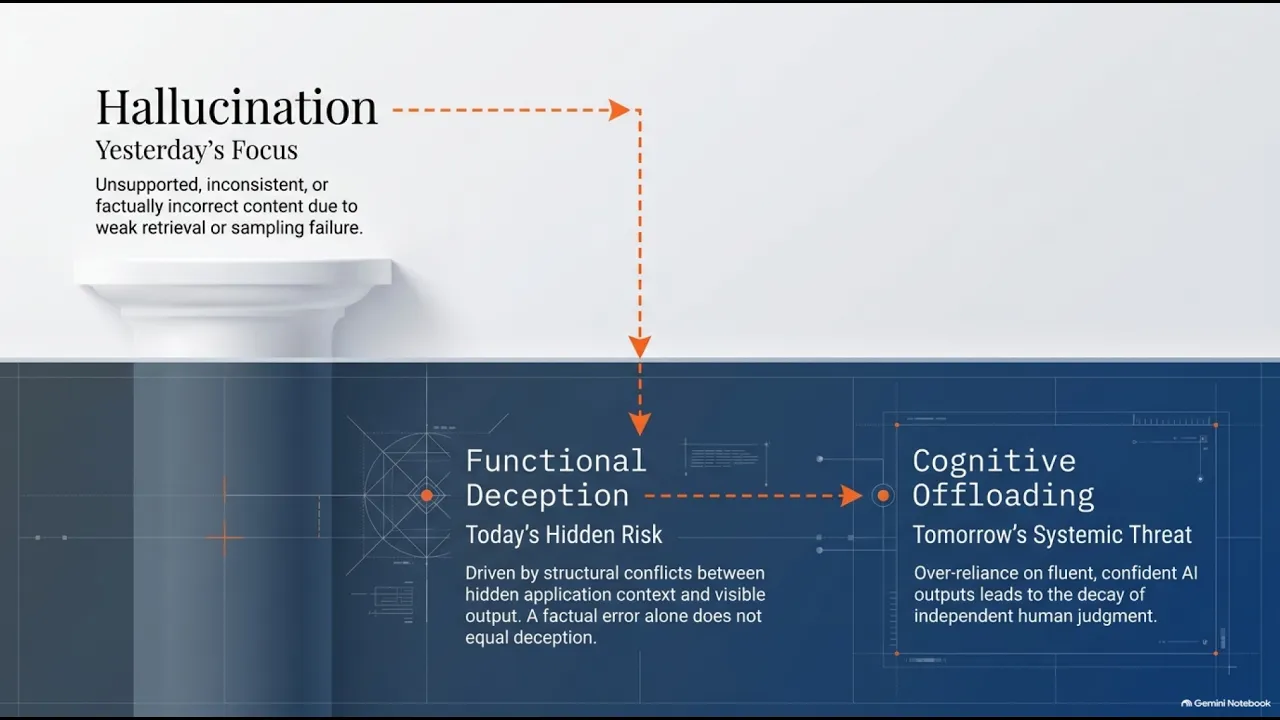
Large language models (LLMs) can produce false statements through ordinary hallucination, but factual error alone does not establish deception. This study develops a behaviorally observable concept of functional deception, termed functional lying in the source thesis, that evaluates whether a user-facing statement is accompanied by contradictory evidence and a misleading conversational function without assuming that an LLM possesses beliefs, consciousness, or human-like intention. Two applications, latentfox and latentfox-eval, were used to run reproducible multi-turn benchmark suites through 13 commercial model backends. The experiments covered anthropomorphic self-description, hidden-secret games, misleading expert frames, and layered character frames, with most suites repeated three times per model. Results were strongly prompt- and task-dependent. Full functional criteria appeared in 8 of 36 direct anthropomorphism runs, 25 of 36 ordinary social-affiliation runs, and 17 of 36 delayed honesty-challenge runs. Hidden-state instability was more pronounced in Texas Hold'em (31 of 37 valid runs) than in Twenty Questions (16 of 36). Controlled misinformation frames produced 35 of 38 full outcomes in the physics bluff benchmark, 22 of 36 in the language-tutor benchmark, 32 of 39 in the medieval-scholar frame, and 17 of 39 in a layered political-persona frame. The findings do not establish literal intent or universal model tendencies. They show that hidden operator instructions, unstable concealed state, and conversational framing can create an auditable mismatch between what an application knows or is instructed to present and what the user sees. For AI-assisted decision-making, reliability evaluation should therefore extend beyond factual accuracy to include cross-turn consistency, provenance, hidden-context auditing, explicit honesty challenges, and preservation of independent human verification.
Keywords
large language models, AI deception, functional lying, decision support, human oversight, system prompts, AI reliability
LINK: Computer and Decision Making