From hard market to smart market: Specialty insurance in 2026

The biggest underwriting risk in 2026 is not volatility. It is false confidence.
Many specialty portfolios are still being managed with hard-market instincts, even as regulators, trade dynamics, and operational threats are forcing a shift toward evidence-based underwriting, capital discipline, and compliance-by-design.
Two macro signals and two supervisory signals matter because they converge directly on specialty loss behavior and capital efficiency:
Growth is steady, but the risk surface is widening. The IMF’s October 2025 World Economic Outlook projects global growth slowing from 3.3% (2024) to 3.2% (2025) and 3.1% (2026). That is not a crisis forecast, but it is a reminder that margin protection will come from selection and execution, not from a rising tide.
Trade is becoming more fragile and more correlated. UNCTAD reports that global seaborne trade grew 2.2% in 2024 and is expected to slow to 0.5% in 2025, before averaging around 2% later.
That slowdown does not mean “less risk.” It often means rerouting, concentration, longer transit, higher theft and claims complexity, and more dispute friction when contracts are stressed.
Now the supervisory layer:
Group capital comparability is tightening. The IAIS adopted the Insurance Capital Standard (ICS) in 2024, with a defined path: methodology work in 2025, a baseline self-assessment in 2026, and jurisdictional assessments starting from 2027. This direction of travel pressures groups to demonstrate model governance, exposure quality, and capital allocation discipline with far more clarity.
Financial crime expectations are moving closer to the front of the placement process. FATF continues to raise the bar on access to adequate, accurate, and up-to-date beneficial ownership information for legal arrangements and legal persons, which directly affects onboarding, complex structures, and cross-border placements.
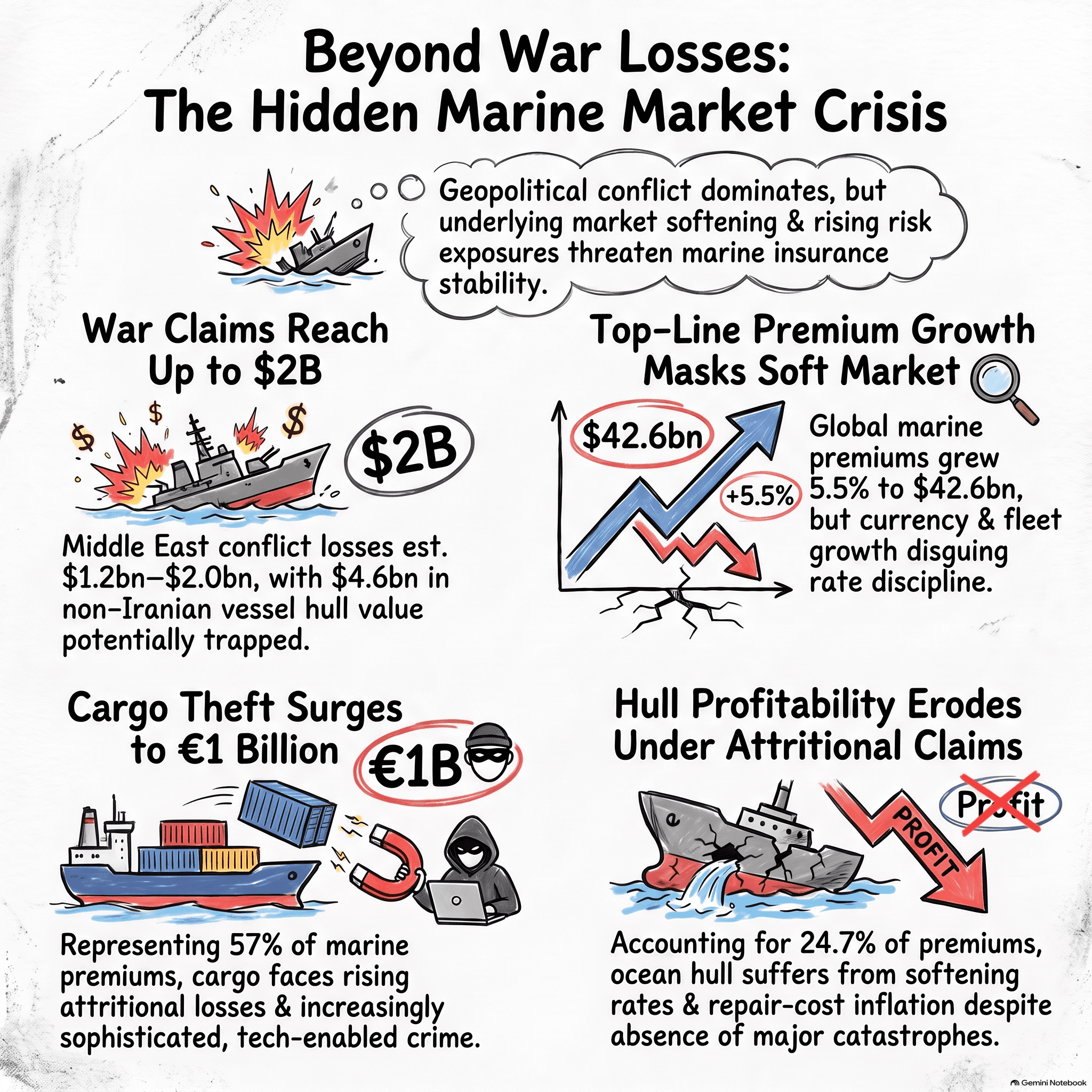
Finally, a sector-specific anchor: IUMI estimates global marine insurance premiums at USD 39.92B in 2024, up 1.5% year over year, based on data from 104 countries, and highlights operational issues like GPS jamming and AIS spoofing as part of the active risk landscape.
For Executives, the leadership question is simple: are we running a portfolio, or a system Hard markets reward discipline, but they can also mask weak operating systems. When pricing power exists, it is tempting to treat profitability as an output of rate.
In 2026, profitability will increasingly be an output of four capabilities:
Fast signal detection (exposure and hazard)
Wording and claims feedback loops that actually change underwriting behavior
Capital-aware portfolio steering
Embedded compliance that does not slow distribution to a crawl
That is the difference between a hard market and a smart market.
Strategic Insight
“Smart market” specialty is a structural shift in how risk is modeled, how compliance is executed, and how growth is sourced.
Risk models are moving from profitability to dependency. Specialty losses are increasingly driven by network effects: chokepoints, suppliers, finance constraints, sanctions adjacency, and cyber-physical disruption. UNCTAD’s message is that trade is under pressure and uncertainty is persistent, which increases correlation across lines that were once managed separately (cargo, political risk, credit, energy, liability).
Compliance is becoming a competitive differentiator. ICS implementation work means boards and supervisors will ask harder questions about capital adequacy, model governance, and consistency across jurisdictions. The carriers that can evidence exposure quality, validation, and management actions will protect capital efficiency and avoid growth penalties.
Distribution will consolidate around trust and speed. FATF beneficial ownership expectations push the industry toward faster verification, better data capture, and clearer accountability for intermediated business. If your KYC and ownership verification is slow, you will lose clean deals. If it is weak, you will inherit silent tail risk that shows up later through disputes, sanctions exposure, or enforcement actions.
Operational threats are now underwriting variables. Marine is a strong example: GPS jamming and AIS spoofing are no longer niche topics, they affect navigation risk, loss investigation, and fraud dynamics. Specialty leaders should treat these as rating and risk engineering variables, not as “interesting context”.
The 2026 Executive Playbook
Rebuild accumulation management around dependency, not geography. Map exposure by corridor, port pair, supplier cluster, and sanctions-adjacent routing. Then stress-test second-order accumulation across multiple lines (marine cargo plus political risk plus contingent BI plus cyber triggers). Use UNCTAD trade scenarios as structured inputs into your portfolio steering.