Academic Article: Cancel culture problem
Abstract
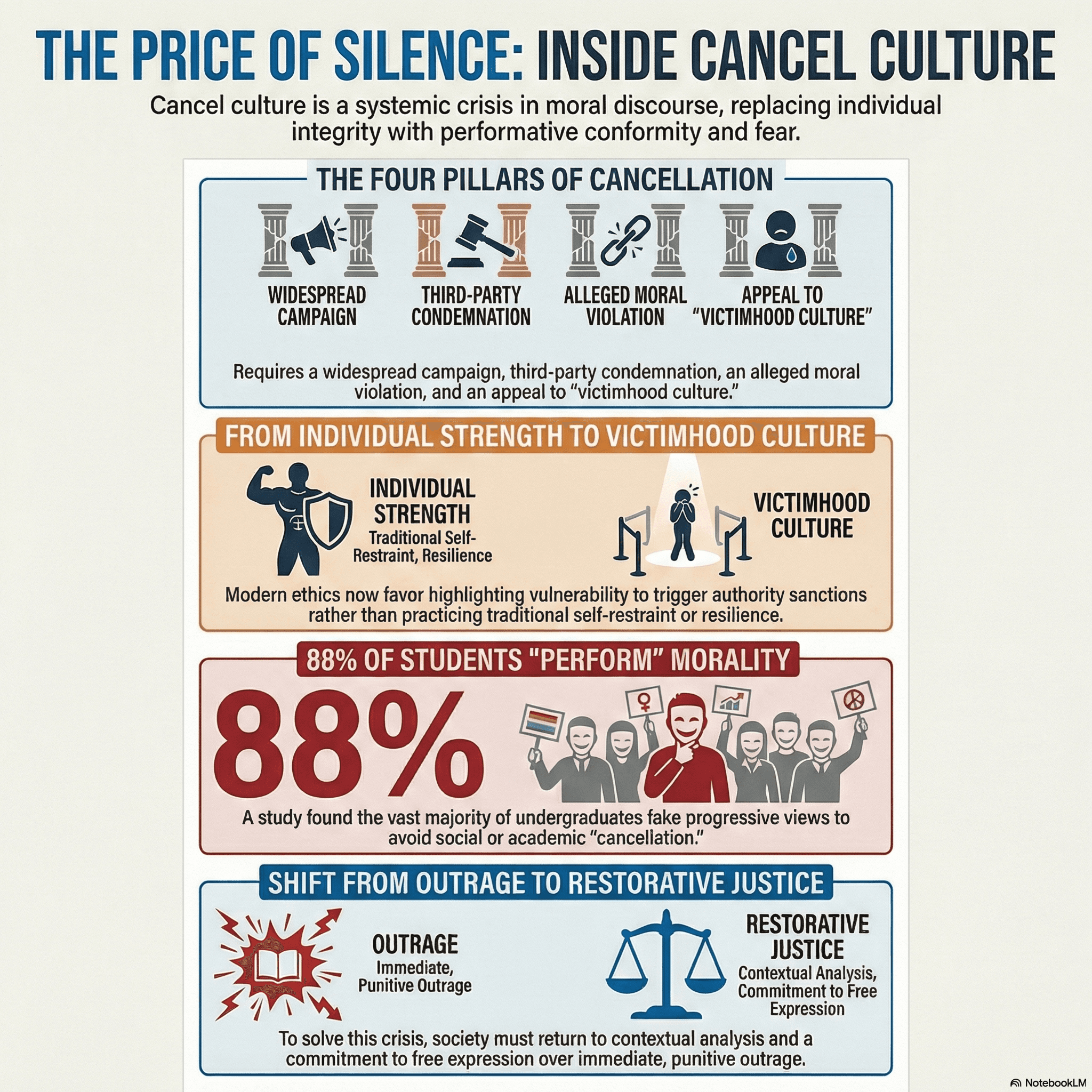
The onset of the digital era, often viewed as a liberating influence for democratizing expression, has resulted in a paradoxical phenomenon: the rise of "cancel culture," a powerful, technology-driven method of social sanction. This article transcends the term's contentious and controversial application to examine its significant impact on the dominant ethical culture. The author presents a specific intentional definition, contending that "cancel culture" is not simply a new form of shaming but unique phenomena. It is defined as (1) a widespread campaign (2) advocating for third-party condemnation of (3) an alleged moral violation, which is justified by (4) a rhetorical invocation of "victimhood culture". This study contends that this framework flourishes in an established context of "normative volatility" and "emotivism," exacerbated by a "hypersensitivity culture" that values emotional comfort above intellectual discourse. The article's primary conclusion is that "cancel culture" operates as an opposing ethical paradigm for discourse, fundamentally incompatible with both conventional liberal-consequentialist ("marketplace of ideas") and classical virtue-based (parrhesia) forms of communication. The study suggests that the phenomenon's primary result is not the instrumental success of any individual cancelation, but rather the widespread "chilling effect" on expression. This serves as a novel moral education that praises conformity, incentivizes performative morality, and intentionally hinders the development of individual character, integrity, and courage. This indicates a systemic crisis in contemporary moral discourse.
Keywords
Cancel Culture, Victimhood Culture, Moral Acceleration, Emotivism, Character Formation, Virtue Ethics
DOI: https://doi.org/10.52152/4bd84a80