Academic Article: Artificial Intelligence-Enabled Financial Reporting and its Role in Improving Investment Efficiency and Firm Performance
Abstract
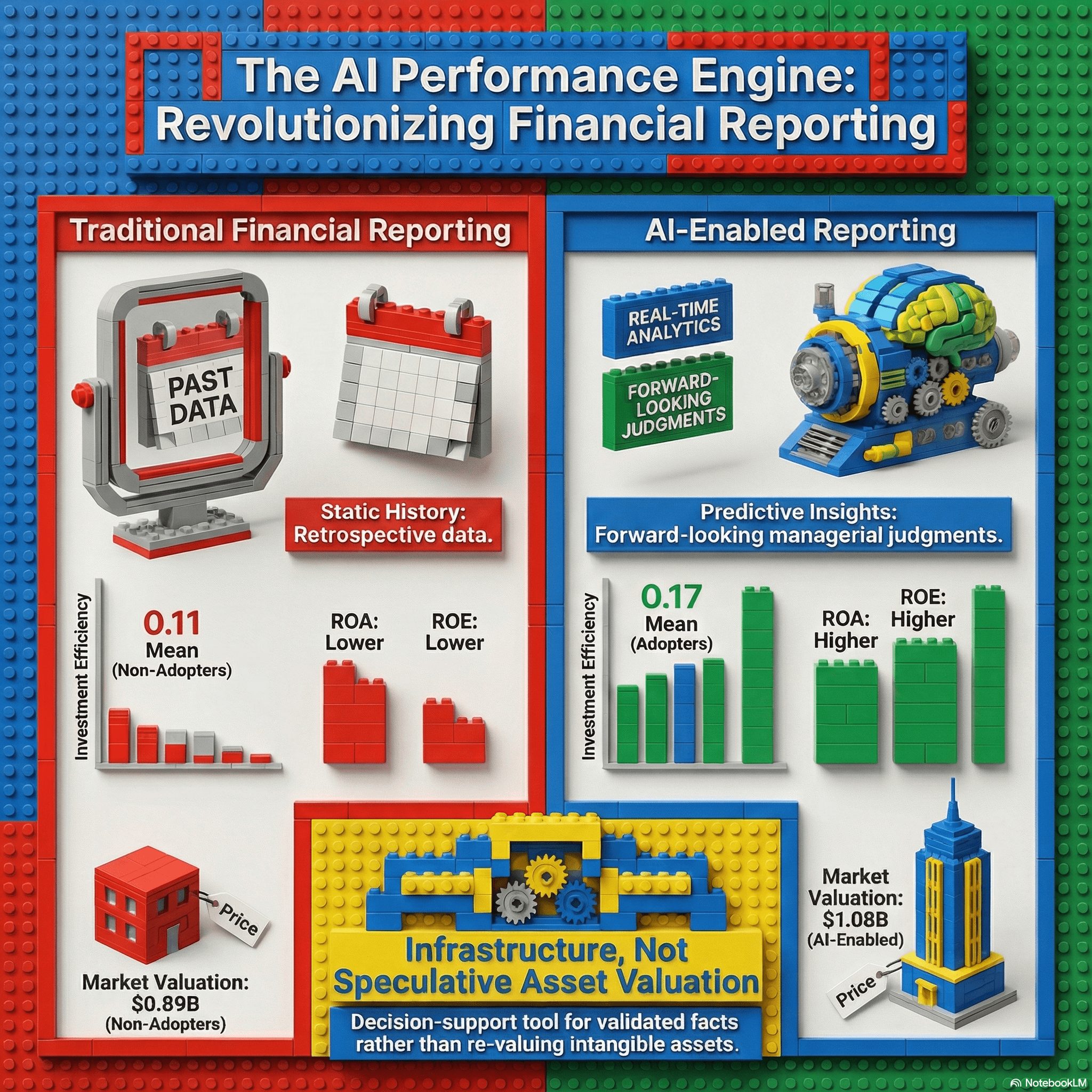
This study analyses the usefulness of artificial intelligence AI-based financial reporting as a system of informational infrastructure, and assesses its effect on investment efficiency, managerial decision-making, and firm performance, and differentiates information enhancement and asset valuation. The research is based on a quantitative, secondary-data approach using 400 firm-years of observation between 2018 and 2022. The financial statements of firms are aggregated with proxy-measures of AI-enabled reporting and digital intensity. Descriptive statistics, correlation tests, and comparative ANOVA are used to evaluate differences between AI-adopting and non-adopting firms across industries. The findings demonstrate that investments are more efficient, profitability and returns on assets and equity are enhanced, and market value is greater in companies that use AI-enabled financial reporting. Such impacts are more acute in digitally intensive industries, indicating that AI supplements current digital frameworks to improve the quality of reports and the accuracy of decisions. The results indicate that AI enhances financial reporting by reducing information asymmetry and enabling future-oriented managerial judgments rather than serving as a valuation mechanism. This has repercussions to managers, investors and regulators who have been demanding higher levels of transparency and efficiency. The study makes a contribution to the accounting and finance literature by conceptualizing AI as an information-advancement technology in financial reporting, thereby providing clearer differentiation from speculative asset valuation tactics.
Keywords
Artificial Intelligence, Financial Reporting, Investment Efficiency, Firm Performance, Information Asymmetry, Digital Intensity